
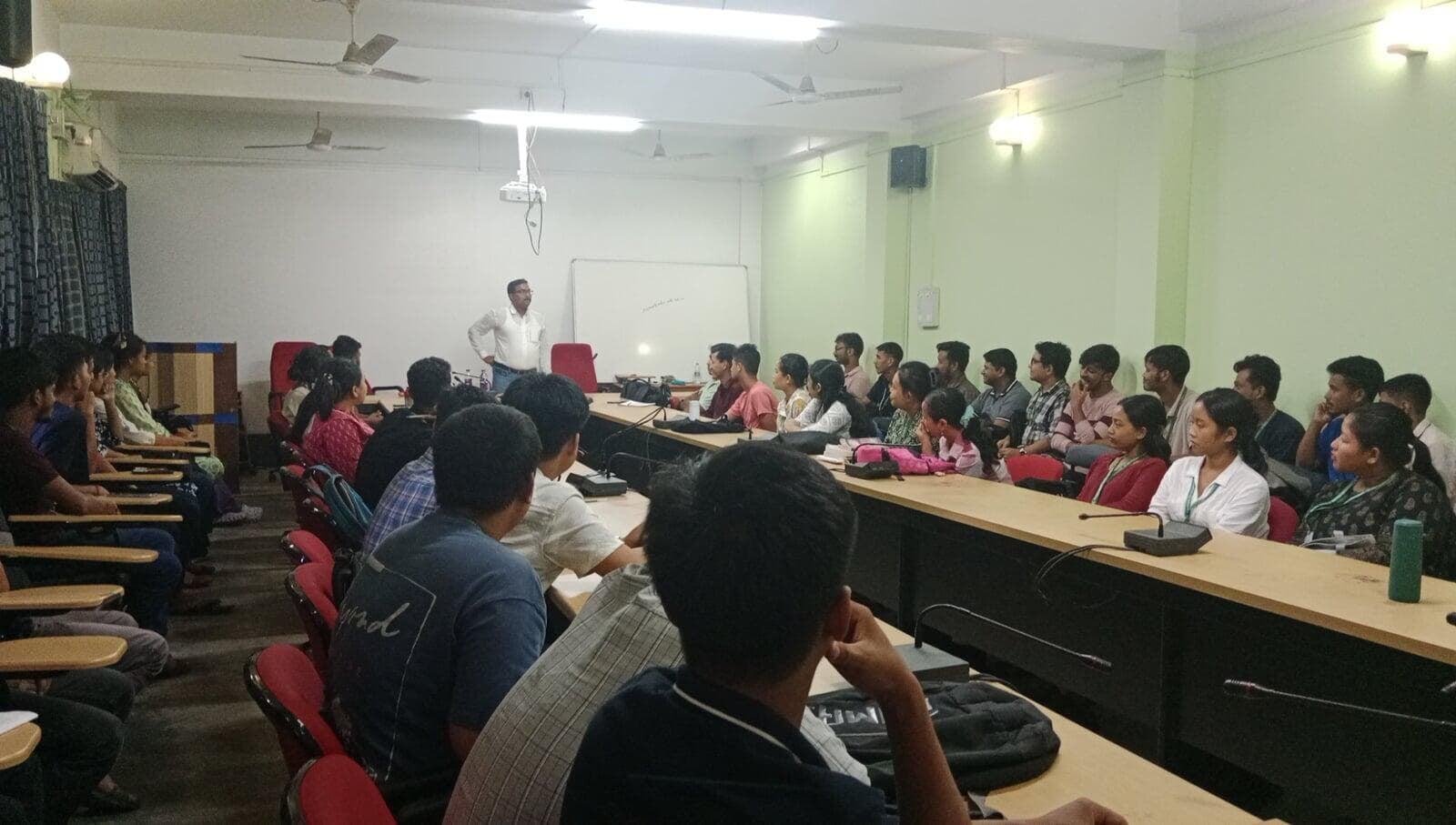
Why Priming Sessions Are Essential?
High-quality online degree programs in Data Science and AI present significant hurdles that often deter even bright students or lead to high attrition rates. Priming sessions directly address these gaps:
- Bridging the Foundational Gap: Many school students lack the advanced mathematical, statistical, and programming fluency required by these university-level courses. Priming ensures a robust transition.
- Confidence and Persistence: The sheer volume and rigor of IIT/IISc curricula can be intimidating. Priming sessions build psychological confidence and resilience, minimizing early discouragement and dropout rates
- Pacing and Self-Discipline: Online learning requires strong self-discipline. Priming introduces students to the required pace and format of asynchronous learning environments
- Optimizing the Learning Path: Students often waste time figuring out the prerequisite skills. Priming maps the prerequisite knowledge directly to the first few modules of the target degree, making the path clear and efficient.
Courses We Handhold
Bachelor of Science (BS) Degree in Data Science and Applications

IIT Madras, India's top technical institute, welcomes you to the world's first 4-year Bachelor of Science (BS) Degree in Data Science and Applications with options to exit earlier in the foundation, diploma or BSc degree level.
Path Integral Methods in Physics & Finance

This NPTEL course, "Path Integral Methods in Physics & Finance," explores the formalism's applications in quantum field theory and the pricing of complex financial derivatives.
Mathematical Foundations for Machine Learning

This course provides mathematical foundations for Machine Learning, focusing on Linear Algebra, Probability and Statistics, and Multivariable Calculus.
Programming, Data Structures And Algorithms Using Python

This NPTEL course introduces programming, data structures, and algorithms using Python, covering basics, sorting, searching, recursion, and object-oriented concepts.
Priming for Online Certifications and Degrees
This dimension of AAE focuses on pre-training and confidence building to ensure students are not only capable of enrolling but also successfully completing demanding online BS/AI and Data Science programs from prestigious institutions like IIT Madras, IIT Roorkee, Indian Institute of Science, and Chennai Mathematical Institute (CMI).
How we plan to Help You!
AAE's approach to priming is multi-faceted, focusing on early intervention and strategic skill development:
Curriculum Mapping: We meticulously map AAE's Level 1 (Foundational) and Level 2 (Functional) modules directly to the initial subjects of the target online degrees (e.g., Mathematics for AI, Programming in Python, Basic Statistics).
Admission Readiness: Offering focused training to help students navigate the eligibility tests and entrance processes specific to IIT Madras (e.g., the Qualifier Exam) and other institutes.
Structured Study Groups: Facilitating peer-to-peer learning and collaborative problem-solving, which is critical for success in complex online courses.
Mentorship and Tracking: Professor Chowdhury and the AAE network provide continuous mentorship, tracking student progress, and offering personalized interventions to address learning bottlenecks.
Technical Handholding: Deepening the Prerequisite Skills
Applied Mathematics
Rigorous review of Linear Algebra (vectors, matrices, systems of equations) and Calculus (derivatives, integration) as applied in ML algorithms.
Statistical Foundations
Deep dive into Probability Theory, Inferential Statistics, Hypothesis Testing, and their implementation using Python libraries like SciPy.
Programming Fluency
Moving beyond basic syntax to master data structures (lists, dictionaries, sets), algorithmic thinking, and efficient use of the applicable python libraries.
Featured Programming Use Cases
To make the priming sessions relevant and engaging, we use real-world programming use cases that students are likely to encounter in their initial university modules. These use cases utilize the foundational Python skills mastered.
AAE In-House
Career Skills Linked Programme (CSLP)
Programme Overview
In this Career Skills Linked Programme (CSLP), you will be able to upgrade your financial data analytics skills by learning the theory and practical application of supervised and unsupervised learning, time-series analysis, neural networks, recommendation engines, regression, and risk modeling, to name a few. The CSLP will be offered through Web Campus of AAE.
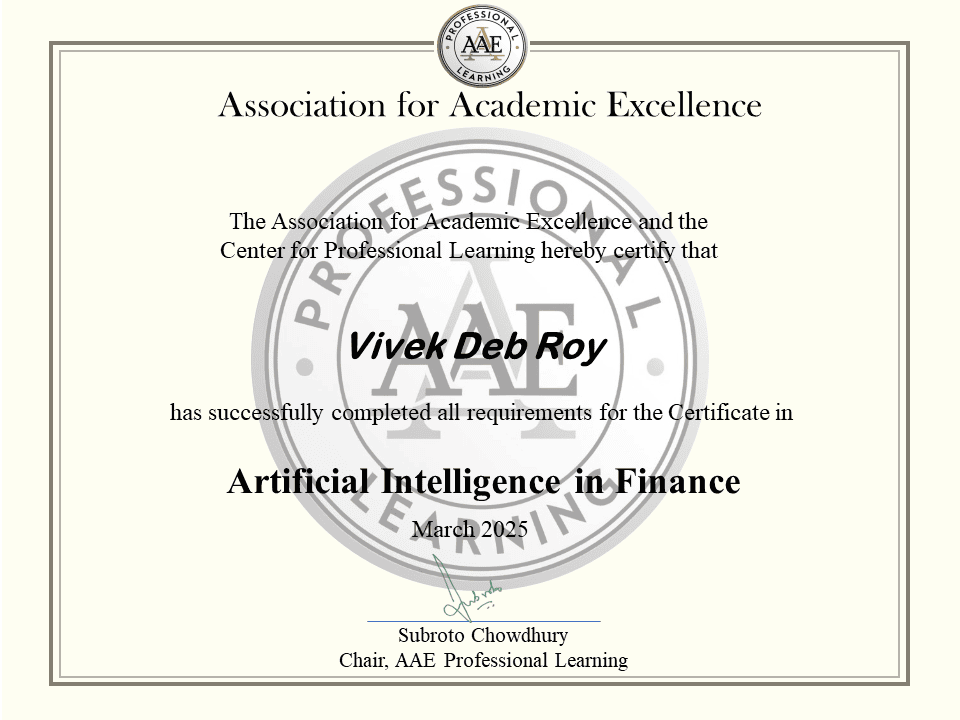
Upon successful fulfillment of requirements, you will receive a certificate of completion from AAE Professional Education at the end of the Programme.
Programme Highlights
1.Live Online Lectures: Attend classes from anywhere through a technology-enabled platform, with sessions conducted primarily on weekends or after business hours.
2.Comprehensive AI & ML Curriculum: Covers a wide range of skill and knowledge areas essential for developing advanced AI solutions.
3.Target Audience: Ideal for B.Tech, MBA, Graduates and finance professionals and software developers aspiring to become expert Machine Learning Engineers and AI Scientists in Finance Domain.
4.Core & Elective Courses: Includes subjects like Advanced Deep Learning, Natural Language Processing (NLP), and more.
5.Hands-on Learning with Industry Tools: Work with Tensor Flow for deep learning, Python libraries for data processing & ML, OpenCV for computer vision, and NLTK for NLP.
6.Capstone Project: Apply acquired AI & ML concepts to real-world projects in the final semester.
7.Continuous Evaluation System: Ensures regular assessments and timely feedback, helping professionals stay on track.
8.Blended Learning Approach: A mix of virtual labs, assignments, case studies, and work-integrated activities.
9.Global Alumni Network: Graduates become part of an elite international professional community.
Courses Offered for 2026
Course Name : Quantitative Finance and Risk Modeling
Master financial risk modeling, risk analysis, and quantitative risk management strategies
Course Name : Financial Risk Forecasting
Predict financial risks using statistical models and data-driven strategies.
Course Name : Statistical Analysis of Financial Data
Analyze financial data using statistical methods for informed decision-making.
Course Name : Machine Learning for Finance
Apply machine learning to optimize financial modeling and investment decisions.
Course Name : Deep Learning and AI in Fintech
Leverage deep learning and AI to innovate financial technology solutions.
What makes cohort based learning most appropriate for financial career skill transfer?
Cohort-based learning is ideal for financial career skill transfer due to its collaborative, interactive environment. Learners engage with peers, apply real-world scenarios, and receive feedback from industry experts. This immersive approach fosters networking, teamwork, and practical application, enhancing applied professional skills.
AAE Web Campus Courses




What is Web Campus Course?
What is Web Campus Course?
In today’s fast-changing business landscape, acquiring new knowledge and skills for BFSI sector through traditional, concept-led courses can be time-consuming and ineffective. With web campus mentored learning courses, you can accelerate your learning, increase productivity, have a better grasp of the subject and discover new problem-solving perspectives.

How do mentorship sessions work?
How do mentorship sessions work?
Mentoring sessions occur in small groups that are called micro classes. You will be grouped with learners with similar years of experience and backgrounds so that the mentors can determine the right pace of teaching, level of techniques, and relevant case studies, to use in order to maximize the benefit. When learning in groups, you can also garner how a practical skill like data science is applied to different industry-specific problems.

What is Data Science Pre-Work?
What is Data Science Pre-Work?
As an aspiring Finance and Fintech professional, R, Python and Statistics play a valuable part in your toolkit. The pre-work lets you acquire foundational knowledge in these subjects and have a better understanding of concepts that are mandatory in data science. It helps you best understand the concepts during the live online sessions with Instructors.

Artificial Intelligence for Finance
The AI for Finance course provides a structured curriculum in four sections. Foundational modules build essential knowledge, Advanced modules enhance applied understanding, and the Professional module focuses on industry applications. Finally, Capstone projects offer hands-on experience, solving real-world financial problems using AI-driven techniques and innovative analytical approaches.
Programme Curriculum
The Programme curriculum is structured in four distinct sections, Foundational modules builds up the fundamental knowledge to pursue the course, followed by Advanced modules shaping the applied understanding, the Professional module orients towards industry applications and capstone projects give taste and feel of real life problem solving.
Introduction to AI in Finance
- Definition and scope of AI in financial services
- AI vs. traditional computing in finance
Natural Language Processing (NLP) in Finance
- Basics of NLP
- AI-driven financial news analysis
- AI in chatbots and customer service
AI in Fraud Detection & Cybersecurity
- How AI identifies fraudulent transactions
- AI-based anomaly detection for cybersecurity
- Ethical considerations in AI fraud detection
AI in Robo-Advisors and Personal Finance
- AI-based financial planning tools
- Robo-advisors vs. human advisors
- AI in expense tracking and budgeting
Hands-on Project
- Develop a simple AI-powered chatbot for answering basic financial queries
Reinforcement Learning in Financial Decision-Making
- Basics of reinforcement learning (RL)
- RL in portfolio optimization and asset allocation
- AI-driven risk-adjusted investment strategies
Deep Learning for Financial Document Processing
- AI in document classification and extraction
- Automating financial report analysis
- AI for contract analysis in banking
AI in Blockchain and Crypto Finance
- AI-powered crypto trading strategies
- Smart contract automation with AI
- AI in decentralized finance (DeFi)
AI-driven Regulatory Compliance and Risk Management
- AI in anti-money laundering (AML) compliance
- AI-powered risk profiling of financial institutions
- Regulatory challenges and AI governance
Hands-on Project
- Build an AI-based financial risk detection tool
Explainable AI (XAI) in Financial Decision-Making
- Importance of explainability in financial AI models
- Techniques for making AI models interpretable
- XAI in credit scoring and loan approvals
AI in Wealth Management and Hedge Funds
- AI-driven wealth management platforms
- AI in hedge fund investment strategies
- Predicting market trends with AI
Autonomous AI Agents in Trading
- AI-powered autonomous trading systems
- Self-learning trading bots
- AI in high-frequency trading (HFT)
Quantum AI in Finance
This is a great place to let your visitors know who you are.
Capstone Project 1
This place will contain explanation about the project
Capstone Project 2
This place will contain explanation about the project
Machine Learning for Finance
Equip learners with expertise in ML-driven financial solutions.
Programme Curriculum
The Programme curriculum is structured in four distinct sections, Foundational modules builds up the fundamental knowledge to pursue the course, followed by Advanced modules shaping the applied understanding, the Professional module orients towards industry applications and capstone projects give taste and feel of real life problem solving.
Introduction to Machine Learning in Finance
- What is Machine Learning?
- Types of ML: Supervised, Unsupervised, Reinforcement Learning
- Common ML algorithms used in finance
Financial Data Processing for ML
- Data preprocessing techniques
- Feature engineering for financial data
- Handling missing and unstructured financial data
Risk Assessment with Machine Learning
- Credit scoring models using ML
- Predicting loan defaults with ML models
Basic ML Models for Investment Analysis
- Linear regression for stock price prediction
- Logistic regression for financial classification problems
Hands-on Project
Build a simple ML model to predict loan approval outcomes
Time Series Analysis and Forecasting
- ARIMA models for stock market predictions
- LSTMs and RNNs for time series forecasting
- ML for macroeconomic trend analysis
Unsupervised Learning in Finance
- Clustering techniques for customer segmentation
- Anomaly detection in financial transactions
- Market segmentation using ML
Quantitative Trading Strategies with ML
- ML-based sentiment analysis for trading
- Reinforcement learning for trading bots
- ML in order book analysis
ML in Algorithmic Trading
- Strategy backtesting with ML models
- ML in trade execution and optimization
- Limitations and risks of ML-based trading
Hands-on Project
- Develop a trading signal detection system using ML
Deep Learning in Financial Market Predictions
- Neural networks in asset price prediction
- Generative models for synthetic financial data
- Autoencoders for risk assessment
Reinforcement Learning for Portfolio Management
- Deep Q-learning in portfolio optimization
- Multi-agent reinforcement learning in hedge funds
- Case studies on ML-driven asset allocation
Extreme ML Models for High-Frequency Trading
- Gradient boosting techniques in HFT
- XGBoost and CatBoost in trading
- ML-driven latency optimization
Fairness and Bias in ML Financial Models
- Understanding bias in ML-based financial decisions
- Techniques to remove bias in credit scoring models
- Ethical considerations in ML-driven investments
Capstone Project 1
This place will contain explanation about the project
Capstone Project 2
This place will contain explanation about the project
Generative AI for Finance
Explore deeper applications of Generative AI in finance, including risk assessment, fraud detection, and financial simulations.
Programme Curriculum
The Programme curriculum is structured in four distinct sections, Foundational modules builds up the fundamental knowledge to pursue the course, followed by Advanced modules shaping the applied understanding, the Professional module orients towards industry applications and capstone projects give taste and feel of real life problem solving.
Introduction to Generative AI
- What is Generative AI?
- Difference between Generative AI and Traditional AI
- Applications of Generative AI in various industries
- Importance of Gen AI in finance
Foundation Models for Finance
- Introduction to Large Language Models (LLMs) (e.g., GPT, Llama, Claude)
- How foundation models work in financial applications
- Understanding generative models like GANs, VAEs, and Diffusion Models
- Ethical considerations of generative AI in finance
AI-generated Financial Reports & Analysis
- Automating financial reporting using Gen AI
- AI-generated market summaries
- AI-assisted earnings call transcript analysis
- NLP-driven financial news generation
Generative AI for Personalized Financial Advice
- AI-driven financial planning assistants
- Chatbots vs. AI-driven financial advisors
- Customizing investment portfolios using Gen AI
- Generative AI for client risk profiling
Hands-on Project
- Build a simple AI chatbot for answering financial questions using LLMs
Generative AI for Risk Modeling & Scenario Simulation
- AI-generated stress testing scenarios for financial risk
- Using Gen AI for Monte Carlo simulations in portfolio risk assessment
- Predicting financial crises using synthetic data
Synthetic Financial Data Generation
- Why generate synthetic financial data?
- Training ML models with AI-generated financial data
- Detecting bias and errors in synthetic data
- Ensuring synthetic data privacy and security
Generative AI for Fraud Detection
- AI-driven anomaly detection using synthetic fraud cases
- Generating adversarial financial transactions to train fraud models
Generative AI for Financial Forecasting & Strategy Optimization
- Using transformer-based models for market prediction
- AI-generated trading strategies
- Automated portfolio rebalancing using Generative AI
Hands-on Project
- Develop an AI model that generates synthetic financial transactions for fraud detection training
Generative AI in Algorithmic Trading & Market Making
- AI-generated trading signals
- Deep reinforcement learning vs. generative trading models
Generative AI for Automated Financial Contracts & Compliance
- AI-driven smart contract generation
- AI-generated regulatory compliance reports
- Automated contract auditing using Gen AI
Autonomous Generative AI Agents in Finance
- Self-learning financial AI agents
- AI-generated investment strategies
- Multi-agent AI systems for financial decision-making
Quantum Generative AI for Financial Modeling
- Introduction to quantum AI in finance
- How quantum computing enhances generative financial modeling
- Future applications of quantum generative AI in risk analysis
Capstone Project 1
This place will contain explanation about the project
Capstone Project 2
This place will contain explanation about the project
Mode of Learning
Mode of Learning – Career Skills Linked Programme (CSLP) at AAE
The Mode of Learning used in this programme is called Career Skills Linked Programme (CSLP). Internationally, CSLP follows a structured educational approach that involves three key stakeholders:
Students – who actively engage in skill-building experiences.
Educational Institutions – that provide structured learning and assessments.
Employer Organizations – offering real-world, work-focused opportunities.
CSLP ensures that students integrate theoretical knowledge with meaningful practice by engaging in purposeful work tasks relevant to their field of study and professional development.
Defining Characteristics of CSLP
An education model can be classified as CSLP if it meets the following criteria:
✔ Industry-Aligned Curriculum: Programmes are developed in collaboration with industry experts.
✔ Work-Focused Learning: Practical, hands-on experiences form a key part of the curriculum.
✔ Seamless Theory-to-Practice Integration: The structure, pedagogy, and assessments ensure students can apply theoretical concepts to professional settings.
The Career Skills Linked Programme (CSLP) at AAE is designed in collaboration with industry leaders, subject matter experts, and academic professionals. This ensures that learners remain relevant in their professions, achieve career growth, and adopt lifelong learning habits.
With continuous workplace-related experiences and weekly online instruction sessions, CSLP ensures a strong integration of theory with practice. Active participation from industry mentors further enhances the learning process, while case studies, simulations, labs, and projects provide hands-on skill development.
The CSLP model at AAE offers a rigorous, technology-enabled education comparable to traditional campus-based programmes. Its flexible, high-quality learning experience allows working professionals to gain in-demand skills at scale, ensuring both career progression and practical expertise.
Eligibility Criteria for Pre-Final Year Students – Career Skills Linked Programme (CSLP) at AAE
Students currently pursuing a degree and having more than 18 months remaining to complete their programme are eligible to apply, provided they meet the following criteria:
✔ B.E. / B.Tech. Students: Must have a strong academic record with at least 60% aggregate marks (or equivalent performance so far).
✔ MCA / M.Sc. or Equivalent Degree Students: Must have at least 60% aggregate marks with university-level Mathematics/Statistics as mandatory subjects.
✔ Technical Proficiency Requirement: Applicants should possess working knowledge of computing and programming to effectively engage with the programme.
This opportunity allows students to gain real-world experience, industry exposure, and advanced skills while completing their degree, enhancing their career prospects upon graduation.
FAQ
Contact classes are conducted over a technology enabled platform. These classes can be attended via the internet using a computer from any location. These contact classes offer similar levels of interactivity as regular classrooms at the campus. These are conducted usually over weekends or after business hours for a total of 7-8 hours per week. If you miss a lecture, you can also access the recorded lecture on the internet.
The programme provides a high degree of interactivity between students and the faculty members and programme instructors. Q&A sessions during the contact classes (which you can attend from anywhere over a technology enabled platform) allow participants to pose questions to the faculty members, and seek guidance through voice and chat. Further interaction with faculty members and peers is enabled through the e-learning portal, by using discussion forums and message boards.
Featured Capstone Projects
The Capstone Projects for AI, ML, and Generative AI in Finance provide hands-on experience in solving real-world financial challenges. Learners apply advanced algorithms to portfolio optimization, risk management, fraud detection, and algorithmic trading. These projects bridge theory and practice, preparing participants for industry roles with data-driven decision-making and AI-powered financial solutions.

AI-Powered Robo-Advisory System
Algorithmic Trading Strategy
Credit Risk Assessment Model
AI-Generated Financial Reports
Student Speak for Mentor of AAE






Case Number : 01
Sunny prepares for a crucial financial analyst interview, showcasing her ability to analyze and classify companies.
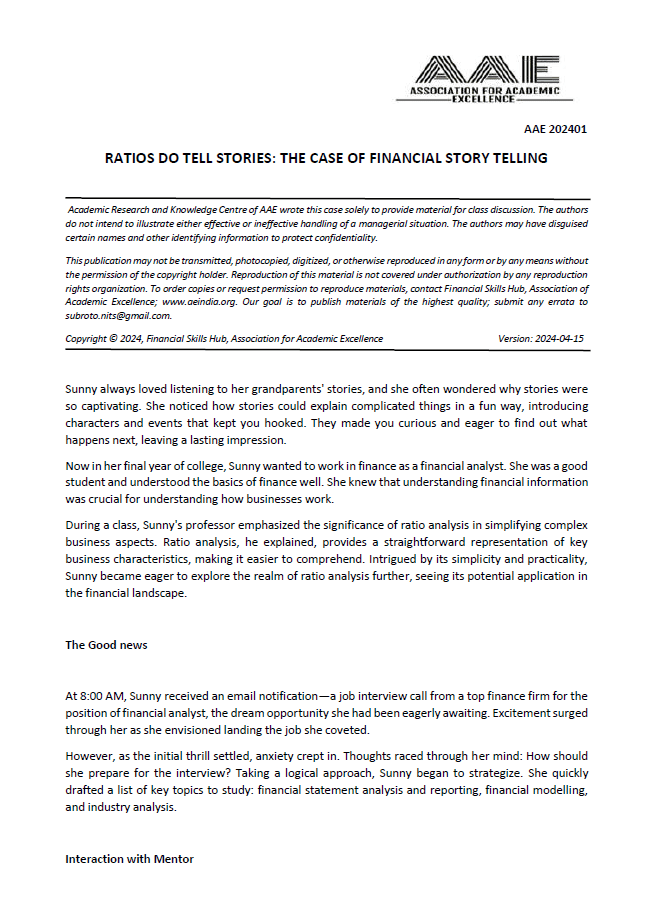
CASE NO: AAE 202401
RATIOS DO TELL STORIES: THE CASE OF FINANCIAL STORY TELLING
RATIOS DO TELL STORIES: THE CASE OF FINANCIAL STORY TELLING
The issue at hand revolves around Sunny's aspiration to become a financial analyst and her journey to prepare for a crucial job interview. As she navigates through the complexities of financial analysis, Sunny grapples with the challenge of analyzing financial data to identify sectors and showcase his analytical skills. The key issue lies in her ability to effectively utilize intuition, common sense, and academic knowledge to interpret the provided financial information, classify companies based on their characteristics, and identify potential sectors to which each company may belong. This case highlights the practical application of financial storytelling and industry classification in the context of a job interview scenario.
Author: ARKC, AAE PUBLISHING - Only for Academic Purpose
Case Number : 02
John Malhotra, an investment advisor, analyzes cash flow to guide clients in volatile Indian stock market.
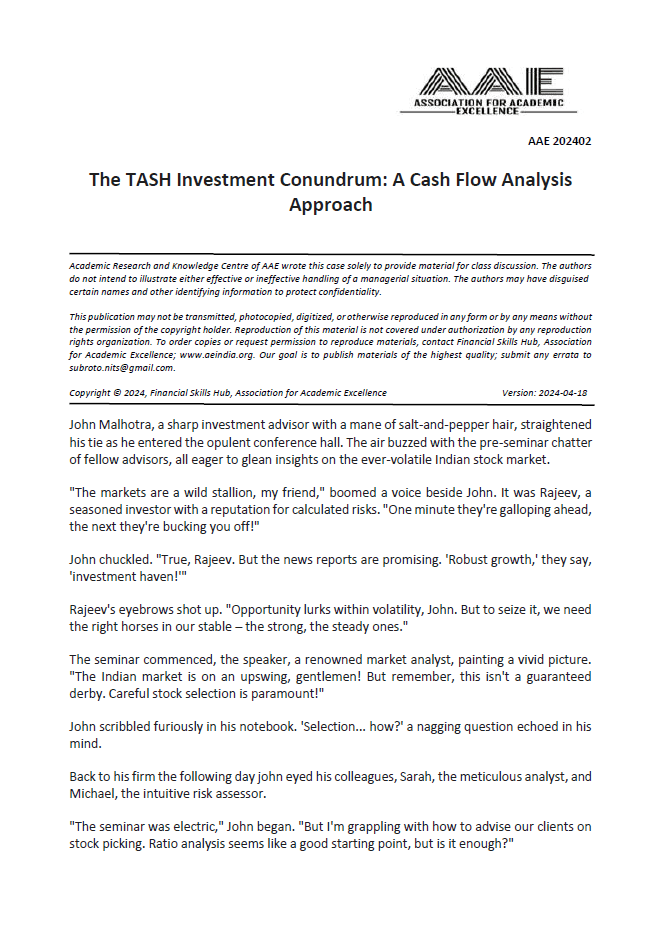
CASE NO: AAE 202402
The TASH Investment Conundrum: A Cash Flow Analysis
Approach
The TASH Investment Conundrum: A Cash Flow Analysis
Approach
The TASH Investment Conundrum: A Cash Flow Analysis Approach" details John Malhotra, an investment advisor, navigating the volatile Indian stock market. John, along with colleagues Sarah and Michael, strategizes on stock selection. He reassures client Mrs. Kapoor by outlining a strategy blending ratio analysis, growth metrics, and historical data to mitigate risks and seize opportunities. The case emphasizes combining quantitative and qualitative factors for balanced portfolio management. John’s team analyzes the cash flow statements of four Indian companies (the TASH companies) to assess financial health and growth prospects, highlighting cash flow analysis in uncovering hidden value. They face a critical decision about diversifying clients' portfolios by investing in the TASH companies, weighing risks and rewards. The case underscores structured, research-based approaches for long-term investment success.
Author: ARKC, AAE PUBLISHING - Only for Academic Purpose
Case Number : 03
Vikram Kumar balances profitability and sustainability to secure investments for Kumar Textiles' growth in Mumbai.
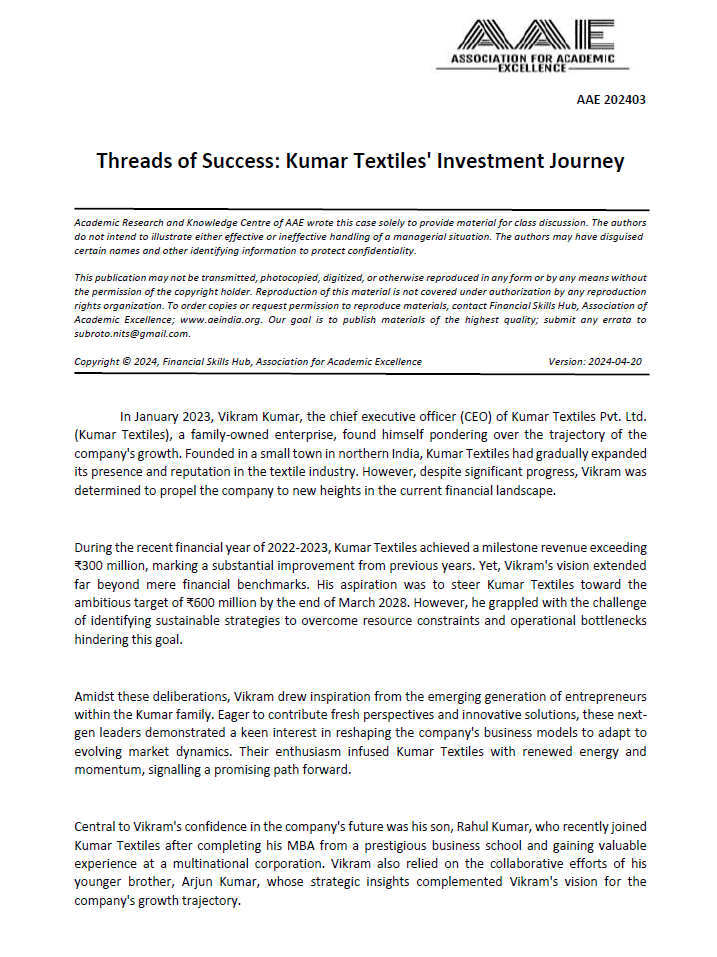
CASE NO: AAE 202403
Threads of Success: Kumar Textiles' Investment Journey
Threads of Success: Kumar Textiles' Investment Journey
Threads of Success: Kumar Textiles' Investment Journey" follows Vikram Kumar, CEO of Kumar Textiles, as he seeks investments to grow his family's textile business in Mumbai. Vikram pitches to potential investors, emphasizing the company’s strong track record and market positioning, but faces the challenge of balancing profitability with sustainability and ethical practices. Investors question the company's projected Return on Invested Capital (ROIC) and strategy for maintaining competitive value. The narrative delves into how Kumar Textiles can differentiate itself in a crowded market while upholding core values. Vikram secures investments from like-minded backers, aiming to achieve financial success and social responsibility. The case provides insights into sustainable growth and values-driven leadership, highlighting the complex balance between investor expectations and ethical business practices.4o
Author: ARKC, AAE PUBLISHING - Only for Academic Purpose
Case Number : 04
Serena Khan addresses cash flow crisis and liquidity management to sustain Modern Fibres' growth amidst challenges.
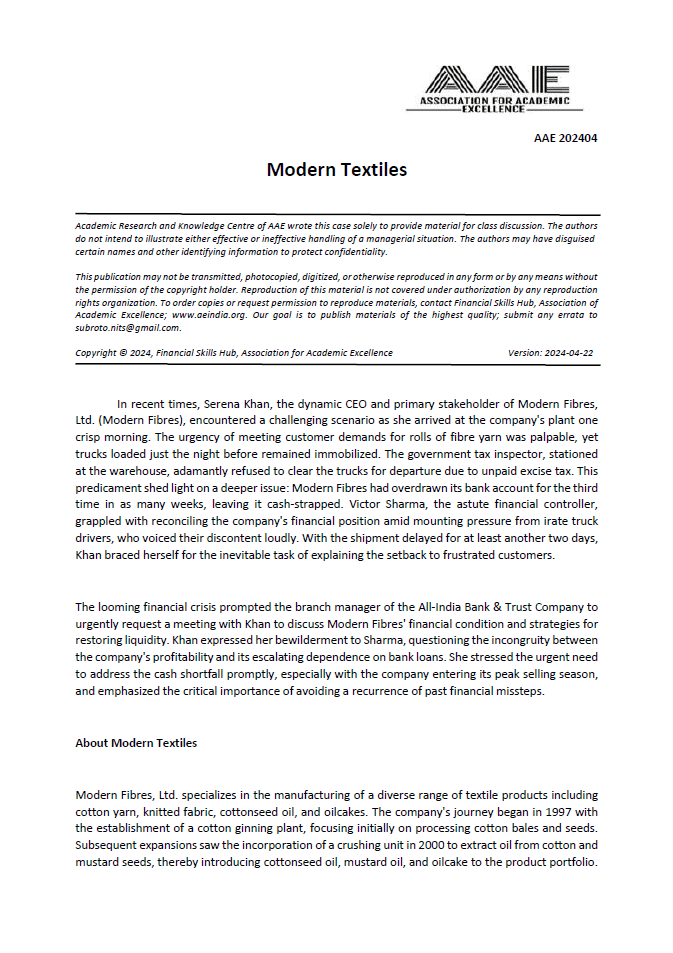
CASE NO: AAE 202404
Modern Textiles
Modern Textiles
In the case study of Modern Fibres, Ltd., CEO Serena Khan faces a cash flow crisis as unpaid excise taxes halt shipments, revealing deeper financial strains. Financial controller Victor Sharma must quickly reconcile the company's position amidst mounting pressure from drivers and customers. With a history of healthy growth since its 1997 founding, Modern Fibres excels in the textile manufacturing industry, emphasizing quality, technology, and sustainability. Despite recent success, the economic challenges, especially post-COVID-19, demand strategic planning. Effective cost management has driven profitability, but the current liquidity issues highlight the need for urgent action. To sustain growth, Khan and Sharma must prioritize liquidity, cost efficiency, and proactive decision-making, ensuring the company remains resilient in the volatile textile market.
Author: ARKC, AAE PUBLISHING - Only for Academic Purpose
Case Number : 05
Students apply the residual income valuation model to ABC Beverages, learning financial modeling and valuation.
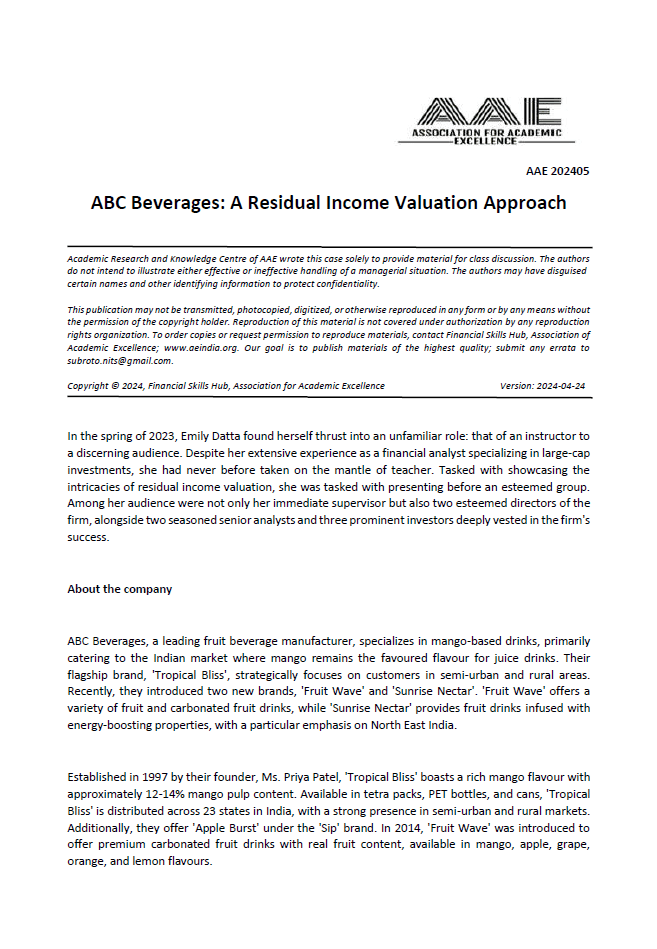
CASE NO: AAE 202405
ABC Beverages : A Residual Income Valuation Approach
ABC Beverages : A Residual Income Valuation Approach
This case study explores the residual income valuation model applied to ABC Beverages, where students use financial data and forecasting assumptions to derive firm and per-share equity valuations as of January 2023. Key learning objectives include understanding the model's mechanics, identifying crucial assumptions from financial statements, and grasping the trade-offs in forecasting models. Suitable for undergraduate and graduate audiences, the case offers practical spreadsheet modeling while fostering theoretical discussions on valuation principles. Students will calculate the per-share value estimate using provided data and the "ABC Beverages Valuation.xlsx" spreadsheet, following steps from sales projection to the aggregation of forecast components, enhancing their understanding of the residual income model's real-world applications.
Author: ARKC, AAE PUBLISHING - Only for Academic Purpose
Case Number : 06
Metro Capital partnered with Apex Auto to expand in automotive components, focusing on innovation and growth.
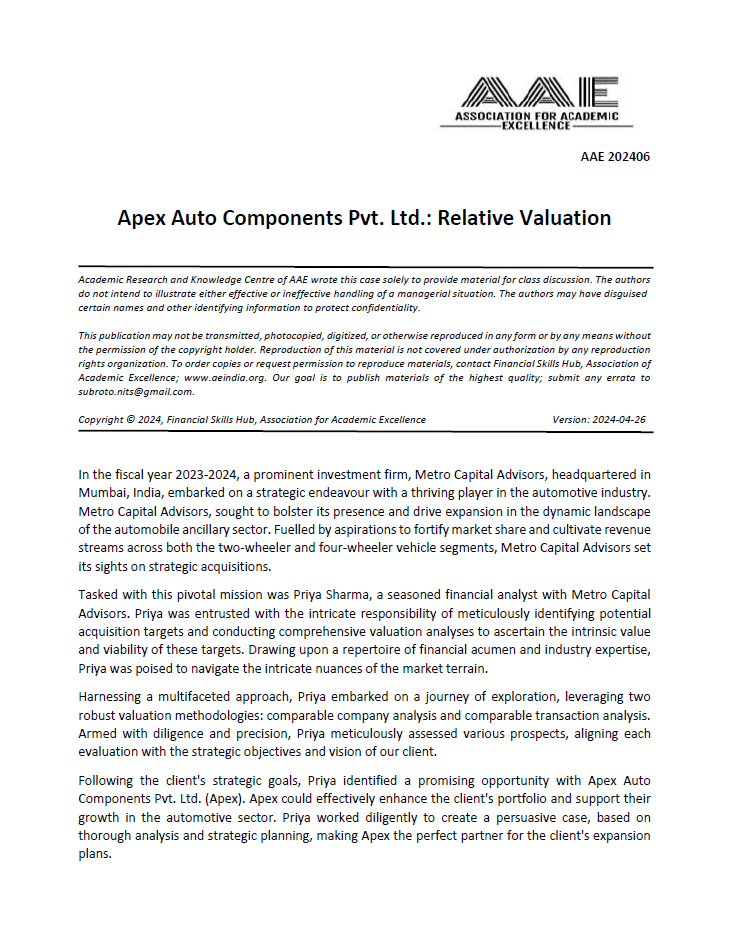
CASE NO: AAE 202406
Apex Auto Components Pvt. Ltd.: Relative Valuation
Apex Auto Components Pvt. Ltd.: Relative Valuation
In fiscal year 2023-2024, Mumbai-based Metro Capital Advisors collaborated with Apex Auto Components Pvt. Ltd. to expand in the automotive ancillary sector. Financial analyst Priya Sharma led the strategic acquisition, utilizing valuation methodologies to identify Apex as a promising target. Established in 1983, Apex manufactures aluminum and ferrous auto components for clients like Honda and General Motors. With 15 advanced facilities, Apex emphasizes innovation, particularly in electric vehicle components, and holds significant market shares in both domestic and international markets.
Apex’s joint ventures and technological alliances enhance its product offerings, including gaskets and chassis components. The company’s R&D and strategic expansions, such as digitization and sustainability initiatives, position it as a leader in automotive innovation, aiming to shape the future of mobility with a focus on electric vehicles.
Author: ARKC, AAE PUBLISHING - Only for Academic Purpose
Case Number : 07
Panther Capital Ventures seized Financial Plaza in Thane, navigating risks with meticulous financing and analysis.

CASE NO: AAE 202407
Unveiling Opportunity: Panther Capital Ventures' Journey to Financial Plaza Acquisition
Unveiling Opportunity: Panther Capital Ventures' Journey to Financial Plaza Acquisition
In bustling Mumbai, Panther Capital Ventures, led by Rohan and Priya, experienced a serendipitous moment when Rohan saved Priya from an accident, forging a bond as "guardian angels." Priya proposed acquiring Financial Plaza in Thane, a promising 90,000 sq ft office property, reflecting the challenging commercial market's rare opportunities. Established in 2005, Panther Capital Ventures initially focused on mezzanine financing before pivoting to direct property acquisitions, seizing on favorable market conditions.
Facing tight credit markets, Aarav structured a financing plan using a non-recourse loan from a life insurance company at 67% LTV and 6.85% interest, minimizing Panther's cash investment. Aarav's financial modeling projected six-year cash flows, emphasizing tenant stability and conservative market assumptions, pivotal for forecasting profitability and mitigating risks. The acquisition strategy included a partnership model with an 8% preferred return for investors, culminating in a structured exit plan with equitable profit sharing.
Armed with meticulous analysis, Panther Capital Ventures navigated uncertainties, ensuring informed decisions aligned with strategic growth and investor returns in the competitive real estate landscape of Thane.
Author: ARKC, AAE PUBLISHING - Only for Academic Purpose
Case Number : 08
IndiRub and BharatLatex explore merger for synergies, navigating downturns, aiming for strategic growth globally.
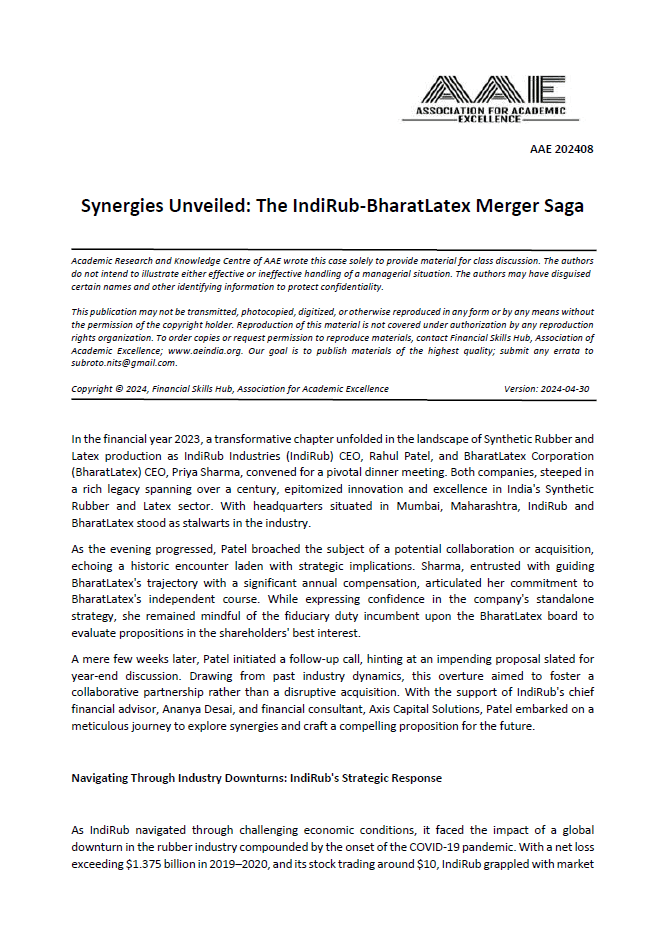
CASE NO: AAE 202408
Synergies Unveiled: The IndiRub-BharatLatex Merger Saga
Synergies Unveiled: The IndiRub-BharatLatex Merger Saga
In the financial year 2023, IndiRub Industries and BharatLatex Corporation, two stalwarts in India's Synthetic Rubber and Latex sector, engaged in transformative discussions. Initiated by IndiRub's CEO Rahul Patel and BharatLatex's CEO Priya Sharma during a pivotal dinner meeting, the dialogue centered on potential collaboration or acquisition. Despite BharatLatex's initial reluctance to disclose sensitive information to a competitor, IndiRub persisted with a revised bid, highlighting synergistic opportunities in cost reduction, efficiency gains, and revenue enhancement estimated at ₹165 million annually post-merger. The proposed alliance aimed to navigate industry downturns and bolster market presence, particularly in lucrative regions like the U.S. and China. With strategic counsel from financial advisors and meticulous planning, IndiRub pursued a merger strategy to optimize financial performance, leverage tax benefits, and capitalize on combined strengths, poised for sustainable growth in the competitive landscape of Synthetic Rubber and Latex production.
Author: ARKC, AAE PUBLISHING - Only for Academic Purpose